
The search ecosystem is evolving rapidly and Microsoft has just made a major move.
In February 2026, Microsoft announced AI Performance reporting inside Bing Webmaster Tools (Public Preview). This update introduces a new layer of visibility for publishers and marketers: tracking how often their content is cited in AI-generated answers across Bing and Microsoft Copilot.
For the first time, search engines are offering structured reporting on AI citations not just clicks, impressions, or rankings.
This marks a foundational shift toward AI Search visibility measurement.
At DareAISearch, we believe this is one of the most important search analytics updates in the last decade.
What Is AI Performance in Bing Webmaster Tools?
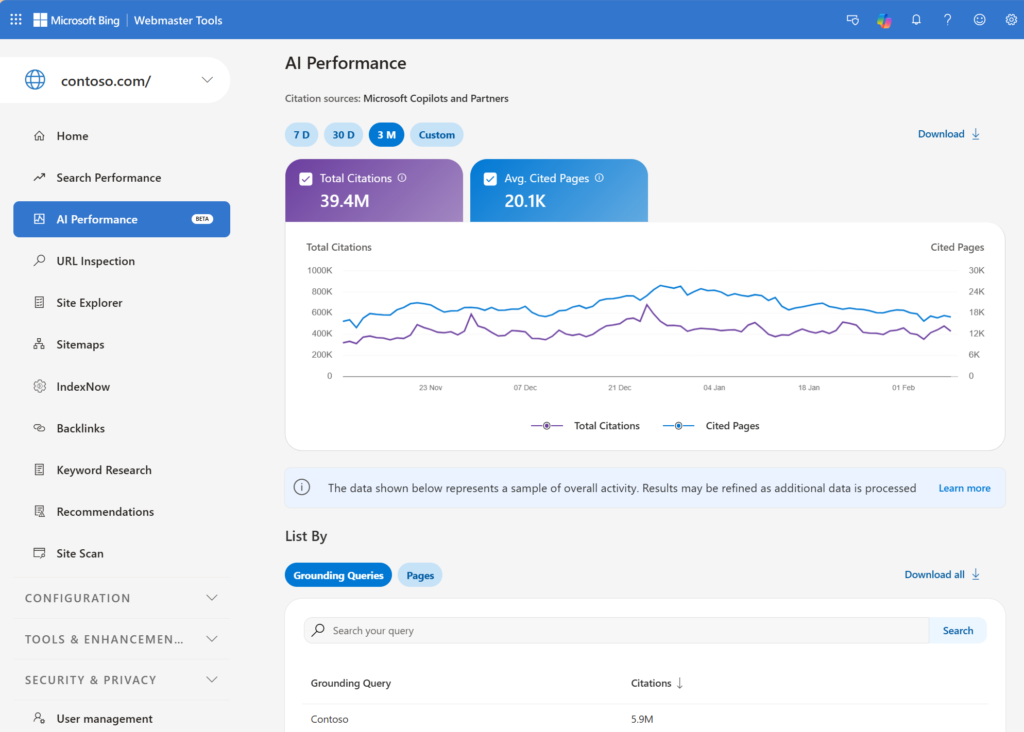
The new AI Performance report is designed to help website owners understand how their content is being used inside AI-generated responses.
Unlike traditional SEO metrics, this feature focuses on:
- Total AI Citations
- Average Cited Pages
- Grounding Queries
- Page-Level Citation Insights
- Citation Trends Over Time
Instead of measuring where you rank, it measures how often AI systems reference your content when generating answers.
That’s a fundamental change.
Why This Update Is Bigger Than It Looks
For years, SEO performance has been measured through:
- Rankings
- Click-through rates
- Impressions
- Organic traffic
But AI-powered search experiences are different.
Users increasingly consume answers directly within AI interfaces. In these experiences:
- The user may not click.
- The AI synthesizes content.
- Visibility is measured through citation and inclusion.
Bing’s AI Performance dashboard signals that AI citations are now measurable assets.
This is the beginning of structured Generative Engine Optimization (GEO).
What Data Does the AI Performance Report Show?
Here’s a breakdown of the key metrics:
Total Citations
How many times your site was referenced in AI-generated answers within a selected timeframe.
This measures AI authority frequency.
Average Cited Pages
The average number of unique URLs cited per day.
This helps identify:
- Whether your AI visibility is concentrated or distributed
- If only one page dominates citations
- Or if you have strong topical depth
Grounding Queries
The queries or prompts AI systems used when retrieving your content.
This is powerful.
It gives insight into:
- Query intent
- AI interpretation patterns
- Emerging conversational phrasing
Page-Level Citation Insights
Which specific pages are being cited most often.
This helps identify:
- AI-optimized content
- High-authority assets
- Pages worth expanding into clusters
Visibility Trends Over Time
Historical citation patterns that show how AI usage changes across time.
This helps correlate:
- Content updates
- Seasonal shifts
- Algorithm changes
- Authority growth
What This Means for SEO & AI Search Strategy
This update confirms something we’ve been saying at DareAISearch since early 2025:
Search is shifting from ranking pages to selecting answers.
In an AI-first search environment:
- Ranking #1 is no longer enough.
- Being cited inside AI responses matters.
- Structured clarity, authority, and entity depth drive visibility.
Traditional SEO optimized for ranking.
GEO optimizes for inclusion in generated answers.
How to Optimize for AI Citations (Generative Engine Optimization Framework)
To increase AI citations inside Bing AI and Copilot experiences:
1. Improve Content Clarity
- Clear headings
- Direct answers under subheadings
- Short summary sections
- FAQ blocks
AI systems prefer structured, scannable formats.
2. Strengthen Topical Authority
- Build clusters, not isolated blogs
- Expand entity coverage
- Deepen semantic context
AI models retrieve based on knowledge depth, not keyword density.
3. Use Structured Data & Schema
- FAQ Schema
- HowTo Schema
- Organization Schema
- Article markup
Schema improves machine interpretation.
4. Update Content Frequently
AI systems prioritize freshness in informational categories.
5. Optimize for Conversational Queries
Grounding Queries reveal how AI phrases user intent.
Content must answer:
- “What is…”
- “How does…”
- “Why should…”
- “Best way to…”
Conversational optimization is now mandatory.
DareAISearch POV: Why This Is Just the Beginning
At DareAISearch, we see this update as validation and not innovation.
We’ve been building AI Search visibility frameworks long before reporting became available.
Here’s our POV:
1. AI Citations Will Become a Core KPI
Just like backlinks became authority signals in early SEO, AI citations will define credibility in the generative era.
2. AI Visibility ≠ Traffic (Yet)
Brands must measure:
- AI Citations
- AI Brand Mentions
- AI Share of Voice
- AI Sentiment Presence
Traffic attribution models will evolve.
3. Multi-Platform AI Tracking Is Critical
Bing’s reporting is a start.
But true AI visibility spans:
- Bing AI
- Copilot
- Gemini
- ChatGPT
- Perplexity
- Other LLM-powered surfaces
AI search visibility requires a cross-platform measurement layer.
4. Generative Engine Optimization (GEO) Is Now a Discipline
SEO optimized for search engines.
GEO optimizes for generative systems.
Different retrieval models.
Different ranking logic.
Different content architecture.
This Bing update officially moves GEO into measurable territory.
The Bigger Shift: From Clicks to Citations
The future of search will revolve around:
- AI-generated answers
- Conversational interfaces
- Zero-click experiences
- Entity-driven retrieval
- Structured knowledge systems
And now for the first time publishers can see how they’re performing inside AI systems.
That’s a major inflection point.
Frequently Asked Questions (FAQs)
AI Performance is a new reporting feature that shows how often your website content is cited in AI-generated answers across Bing and Microsoft Copilot experiences.
Not necessarily. AI citations measure inclusion in generated answers, not direct clicks. However, strong citation frequency signals authority and improves long-term AI search visibility.
Traditional SEO measures rankings and clicks. AI Performance measures how often AI systems reference your content when generating answers.
Improve content clarity, strengthen topical authority, use structured data, update content regularly, and optimize for conversational queries.
No. GEO complements SEO. Traditional SEO helps you rank; GEO helps you get cited inside AI-generated answers. Both are essential in the modern search ecosystem.
Related posts:
 The Definitive Guide to Generative Engine Optimization (GEO)
 AI Search vs Traditional Search: Mental Models for Marketers
 The AI Visibility Funnel: From Mention to Citation to Choice
 ChatGPT Health Is Live: How It Will Transform Discovery, Trust, and Growth for Healthcare Brands
 ChatGPT 5.3 Is Here: What It Really Means for the Future of AI Search